

 RU
RU  EN
EN  ES
ES  AR
AR Synthetic Resin Roofing Tile Manufacturing Process: A Comprehensive, In-Depth Explanation
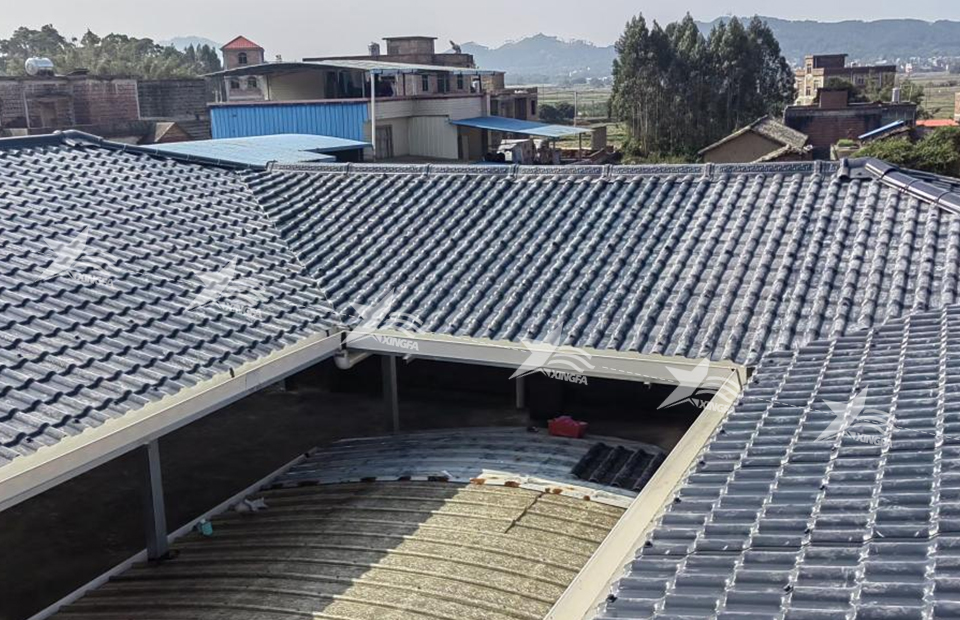
As a mainstream roofing material, synthetic resin roofing tiles are widely applied in residential buildings, industrial plants, and building renovation projects—thanks to their outstanding weather resistance, waterproofing performance, and lightweight characteristics. While many stakeholders focus solely on the finished product’s technical specifications, they often overlook a critical fact: the manufacturing process directly determines product quality, service life, and anti-aging capability. The significant quality disparity observed across the market stems fundamentally from variations in raw material formulation, extrusion molding, co-extrusion technology, and cooling/setting processes. This article systematically outlines the complete manufacturing workflow of synthetic resin roofing tiles—from raw material selection and compounding, through co-extrusion, shaping and cooling, post-processing, to final quality inspection—highlighting key technical requirements at each stage.
1. Raw Material Selection and Formula Compounding: The Foundation of Product Performance
Polyvinyl chloride (PVC) serves as the primary matrix resin for most synthetic resin roofing tiles. High-performance products further incorporate an acrylonitrile–styrene–acrylate (ASA) weather-resistant top layer via co-extrusion. Precise raw material formulation thus constitutes the first and most critical process step. The base material consists of PVC resin powder, compounded with thermal stabilizers, impact modifiers, processing aids, calcium carbonate (CaCO₃) filler, and lubricants. Thermal stabilizers inhibit decomposition and aging during high-temperature processing and prolonged outdoor UV exposure; impact modifiers enhance low-temperature toughness and resistance to impact-induced cracking; while CaCO₃ filler helps control production costs. However, excessive filler content significantly compromises mechanical strength and weather resistance. Substandard products frequently overuse fillers at the expense of resin content, resulting in inferior performance.
The ASA weather-resistant top layer is formulated separately. ASA resin offers exceptional UV resistance and is compounded with color masterbatches and antioxidants. After formulation, the mixture undergoes sequential high-speed hot mixing and cold mixing. During hot mixing, temperature-controlled agitation ensures uniform dispersion of all additives and thorough integration of resins and functional agents. Subsequent cold mixing rapidly reduces the material temperature to prevent premature degradation or agglomeration. The compounded material is then aged for a specified period to relieve internal stresses—ensuring stable, consistent extrusion behavior downstream. Inadequate control over this compounding process may lead to visible color variation, embrittlement, or rapid fading within a short service period.
2. Co-Extrusion Process: The Determinant of Surface Weather Resistance
Premium synthetic resin roofing tiles employ a two-layer co-extrusion process—a definitive differentiator between high- and low-grade products. The production line features dual extruders: a main extruder for the PVC substrate and a secondary extruder dedicated to the ASA weather-resistant layer. The molten streams converge within a precision-engineered co-extrusion die head, where they fuse under controlled temperature and pressure to form a monolithic, integrally bonded structure in a single pass—distinct from post-fabrication surface coating. Coated tiles suffer from poor interfacial adhesion, leading to peeling and delamination over time; by contrast, co-extruded tiles exhibit superior interlayer bonding and long-term integrity.
Extrusion temperature and screw rotation speed constitute the two most critical process parameters. As a thermally sensitive polymer, PVC degrades readily at elevated temperatures—resulting in carbonization, black streaks, or voids—while insufficient temperature leads to incomplete plasticization and compromised toughness. Screw speed governs melt throughput and must be precisely synchronized between both extruders to ensure uniform ASA layer thickness and consistent interfacial bonding. Per national standards, high-quality resin tiles maintain an ASA weather-resistant layer thickness of ≥0.15 mm. In contrast, low-cost alternatives often feature an extremely thin or even absent ASA layer—relying instead on standard color masterbatches—leading to extensive fading and chalking after only two to three years of outdoor exposure.
3. Shaping and Cooling/Setting: Defining Structural Geometry and Dimensional Stability
Immediately upon exiting the die head, the molten composite sheet enters the profile-forming station. Forming rollers—engraved with precise corrugated or trapezoidal patterns—press the sheet into its final wave-shaped geometry in a single continuous operation. Critical dimensional parameters—including wave pitch, wave height, and effective width—are strictly maintained to meet design specifications. Die precision directly affects tile interlocking performance; die wear induces geometric distortion, resulting in oversized lap gaps during installation and creating latent roof leakage risks.
Subsequent to forming, the sheet proceeds to the cooling and setting stage, where a hybrid water-cooling and air-cooling system enables rapid, uniform heat dissipation. Given the high initial temperature of the extrudate, controlled, homogeneous cooling is essential to release internal thermal stresses—thereby minimizing post-manufacturing shrinkage, cambering, or torsional deformation. Cooling rate must be meticulously optimized: excessively rapid cooling traps residual stress, increasing susceptibility to warping under thermal cycling; conversely, overly slow cooling compromises shape retention, causing sagging and reduced flatness. Upon completion of this stage, the sheet achieves sufficient rigidity and dimensional stability for downstream handling.
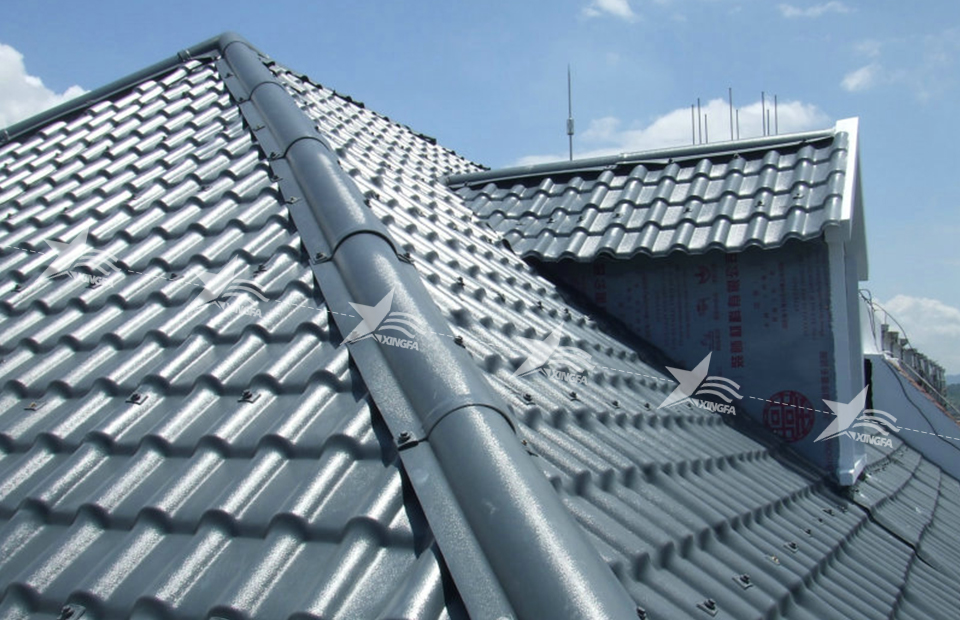
4. Traction, Cutting, and Accessory Fabrication: Post-Processing Operations
The cooled and set sheet is conveyed forward at constant speed by a traction unit, with traction velocity precisely matched to extrusion output to prevent tensile distortion. Upon reaching the pre-programmed length, a CNC-controlled cutting system performs automatic, high-precision trimming—ensuring length tolerance remains within permissible limits. Cut edges must be clean and free of chipping or micro-cracks, as defective cut surfaces act as stress concentration points prone to cracking during subsequent handling or installation.
Following main-tile production, complementary roofing accessories—including ridge caps, hip caps, three-way junctions, and eave closures—are fabricated concurrently. These components are typically formed via secondary thermoforming of the same base material, ensuring identical composition and matching coefficients of thermal expansion. This compatibility prevents differential aging—where accessories degrade prematurely while main tiles remain intact. Finished tiles are stacked neatly with appropriate interlayer protection to prevent deformation caused by stacking pressure.
5. Final Inspection and Warehousing: Ensuring Outbound Quality Control
Each batch of finished tiles undergoes rigorous multi-point quality verification prior to packaging and warehousing. Inspection items include visual assessment (for bubbles, scratches, color inconsistency, or material deficiency), dimensional measurement (thickness, wave height, overall length), and representative sampling for accelerated weathering tests and low-temperature drop-weight impact testing—simulating real-world wind, snow, and thermal stress conditions. Nonconforming units are reprocessed; no substandard product is permitted to enter the market.
Warehousing practices also warrant strict attention. Storage areas must be level and sheltered; prolonged outdoor exposure to direct sunlight must be avoided to prevent premature photo-oxidative degradation. Packaging must provide adequate physical protection, and transportation must minimize impact and vibration.
Заключение
The entire manufacturing process for synthetic resin roofing tiles is an integrated, interdependent system—where raw material formulation, co-extrusion execution, and cooling/setting control collectively define product longevity and reliability. In essence, conventional single-layer PVC tiles involve simpler, lower-cost production but offer limited weather resistance; whereas ASA-based two-layer co-extruded tiles entail more complex, higher-cost manufacturing—yet deliver markedly superior anti-aging performance.
When selecting roofing materials, end users should look beyond aesthetic appearance and structural profile—and instead evaluate underlying manufacturing methodology, distinguishing true co-extruded products from superficially coated alternatives. Properly engineered and manufactured resin tiles can reliably serve for approximately 20 years under normal environmental conditions; conversely, substandard, cost-cutting variants often exhibit severe fading, cracking, and functional failure within just a few years—jeopardizing roof integrity and safety.