RU
RU  EN
EN  ES
ES  AR
AR Does the Service Life of Synthetic Resin Roofing Tiles Correlate with Thickness? A Multidimensional Comparative Analysis

Synthetic resin roofing tiles are widely used for industrial factories, warehouses, and residential roofs. Many procurement professionals question whether thicker tiles inherently offer longer service life. While some vendors promote “thicker = more durable” and “thinner = prone to failure,” thickness is only one of several interdependent factors influencing longevity and cannot, on its own, reliably indicate product durability. In reality, the service life of synthetic resin roofing tiles depends on tile thickness, material formulation, surface weather-resistant layer quality, service environment, and installation practices. This article systematically examines the relationship between thickness and service life from multiple dimensions: the mechanical role of thickness, the decisive influence of material formulation, application-specific suitability across thickness grades, environmental load conditions, and installation methodology.
1. Mechanisms by Which Thickness Influences Service Life
(A) Thickness and Structural Load-Bearing Capacity
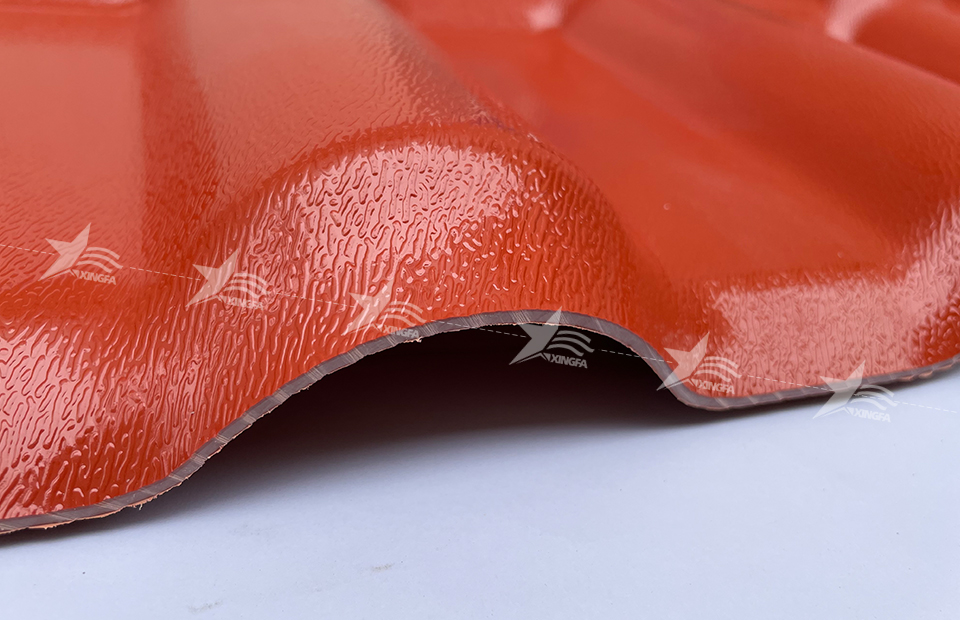
Conventional synthetic resin roofing tiles are available in standard thicknesses of 2.0 mm, 2.5 mm, and 3.0 mm. Assuming identical material formulations, increased thickness enhances flexural strength and impact resistance. Under snow loads, hail impact, or foot traffic during maintenance, thicker tiles exhibit reduced susceptibility to bending, cracking, or permanent deformation. Conversely, thinner tiles possess less base material and lower rigidity; when installed over excessively spaced purlins, they may sag progressively under sustained load—inducing continuous internal stress that accelerates molecular degradation of the resin matrix and shortens service life. In regions subject to heavy snowfall or strong winds, insufficient thickness can directly lead to tile distortion or structural failure.
(B) Thickness ≠ Weather-Resistant Layer Thickness
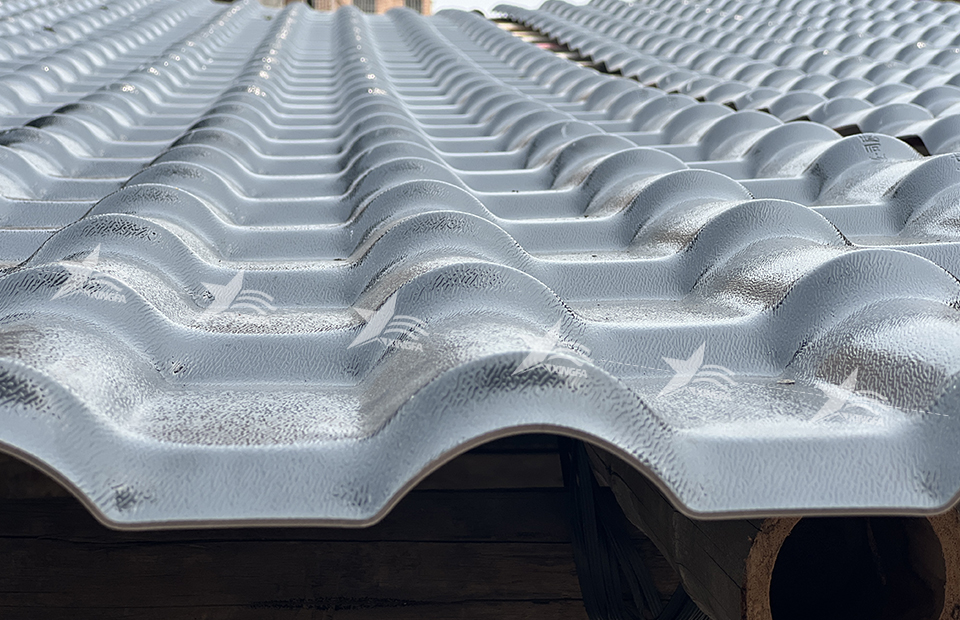
A critical distinction must be emphasized: total tile thickness does not equate to the thickness of the ASA (acrylonitrile–styrene–acrylate) weather-resistant co-extruded layer. In high-quality co-extruded synthetic resin tiles, the ASA top layer typically measures only 0.15–0.3 mm, while the bulk substrate consists of PVC-based material. UV resistance, anti-aging performance, and color retention are governed primarily by the ASA surface layer—not by the thickness of the underlying substrate. Some manufacturers simply increase the PVC substrate thickness while maintaining an ultra-thin ASA layer. Even at a total thickness of 3.0 mm, such products rapidly fade and chalk under prolonged solar exposure. Thus, increasing substrate thickness alone improves mechanical strength but delivers negligible enhancement in long-term weathering resistance.
2. Material Formulation: A More Critical Determinant of Service Life Than Thickness
(A) Raw Material Quality as a Decisive Factor
Even among tiles of identical nominal thickness (e.g., 3.0 mm), service life varies dramatically between those manufactured from virgin materials versus those heavily loaded with calcium carbonate fillers or recycled scrap. High-grade virgin-material tiles incorporate sufficient UV absorbers and thermal stabilizers, ensuring molecular stability and long-term integrity. In contrast, low-quality tiles with excessive filler content exhibit pronounced brittleness: despite meeting dimensional specifications, they are prone to low-temperature cracking and rapid chalking under sunlight. Many end users focus solely on thickness while overlooking raw material composition—resulting in premature failure of ostensibly “thick” tiles.
(B) Quality of the ASA Co-Extruded Layer
The ASA layer functions as the tile’s primary protective “outer shell,” shielding against UV radiation and acid rain corrosion. Premium-grade ASA co-extrusion delivers superior weatherability. By contrast, laminated (film-applied) alternatives—even on thick substrates—suffer from delamination, blistering, or peeling over time. Once compromised, the exposed PVC substrate undergoes accelerated degradation. In such cases, increased thickness provides no meaningful extension of service life.
3. Application-Specific Suitability and Service Life Expectancy by Thickness Grade
(A) 2.0 mm Synthetic Resin Roofing Tiles
Lightweight and cost-effective, these tiles are best suited for southern regions with minimal snowfall, interior ceilings, or temporary/low-load structures. When fabricated from high-quality virgin materials and installed with purlin spacing ≤ 660 mm, their typical service life under normal environmental conditions ranges from 10 to 15 years. Their principal limitation lies in relatively low load-bearing capacity—making them unsuitable for snow-prone areas or roofs requiring frequent human access for maintenance.
(B) 2.5 mm Synthetic Resin Roofing Tiles
This thickness represents the market mainstream, offering an optimal balance among weight, structural performance, and cost-efficiency. Widely deployed across general-purpose industrial buildings, warehouses, and residential roofs, 2.5 mm tiles made from virgin materials via co-extrusion technology achieve a service life of 15–20 years under favorable environmental conditions. They withstand moderate snow accumulation and tolerate incidental foot traffic with greater margin for error—rendering them the most cost-effective solution for most applications.
(C) 3.0 mm Synthetic Resin Roofing Tiles
Offering the highest structural strength, impact resistance, and load-bearing capacity, 3.0 mm tiles are recommended for northern regions with heavy snowfall and large-scale steel-framed industrial facilities requiring regular roof access. When produced from premium virgin materials with high-performance ASA co-extrusion and installed per specification, their expected service life approaches 20 years. However, increased self-weight imposes higher demands on purlin load capacity and raises overall project costs. Critically, if inferior raw materials are used, a 3.0 mm tile may perform worse than a 2.5 mm tile made from high-grade virgin material.
4. Environmental Factors That Modulate the Thickness–Service Life Relationship
Even with identical thickness and material composition, ambient conditions significantly affect actual service life. In southern regions characterized by high temperatures and intense UV exposure, photochemical degradation dominates; here, the quality and integrity of the ASA weather-resistant layer take precedence over thickness. In northern cold-climate zones, mechanical damage from snow accumulation and freeze–thaw cycling becomes the primary failure mode—making thickness comparatively more influential. In chemical plants or coastal environments, acidic mists or salt-laden aerosols aggressively attack the surface layer; once the ASA protection is compromised, increased substrate thickness offers no mitigation against chemical corrosion. Conversely, in dry, clean, low-stress environments—such as standard storage warehouses—moderate thickness suffices to ensure long-term reliability.
5. Installation Practices: Amplifying or Nullifying the Benefits of Thickness
The structural advantages conferred by greater thickness can be entirely negated by substandard installation. Excessive purlin spacing—even with 3.0 mm tiles—can induce roof deflection, generating persistent internal stresses that accelerate microcracking and aging. Similarly, improper fastener torque or omission of thermal expansion gaps will cause thick tiles to crack prematurely. Conversely, meticulous installation—including optimized purlin layout, correct fastening protocols, and adequate provision for thermal movement—enables even 2.5 mm high-performance tiles to deliver stable, long-term service. Only through appropriate installation practices can the inherent structural benefits of increased thickness be fully realized.
6. Selection Summary: How to Reasonably Determine Thickness
In summary, the service life of synthetic resin roofing tiles is related to thickness—but not in a directly proportional manner. Thickness primarily influences load-bearing capacity and impact resistance, thereby determining whether the tile will suffer physical fracture; whereas weathering resistance, colorfastness, and resistance to chalking are predominantly governed by the ASA weather-resistant layer and the base material formulation.
Therefore, thickness alone should not be the sole criterion for selection. Instead, a comprehensive evaluation must be conducted—considering local climatic conditions, roof loading requirements, and the corrosive environment of the facility. For standard industrial buildings in southern regions, priority should be given to the quality of the ASA co-extruded layer, with a medium thickness being generally sufficient. In contrast, for industrial buildings in northern regions subject to heavy snowfall, tile thickness should be moderately increased—provided that high-quality raw materials are maintained. Only by holistically optimizing thickness, raw material selection, weather-resistant layer performance, and compliance with proper installation practices can the designed service life of synthetic resin roofing tiles be fully realized.